Three amino acids and one copper ion make up GHK-Cu, one of the most widely cited small peptides in the research literature. Its chemistry is compact and well characterized, and that makes it a useful reference compound. This profile covers what GHK-Cu is, how it is built and how its identity and purity are checked before it reaches a research bench.
Identity at a Glance
GHK-Cu is the copper(II) complex of the tripeptide glycyl-L-histidyl-L-lysine. The name comes from the one-letter amino acid codes: G for glycine, H for histidine and K for lysine.
- Sequence: Gly-His-Lys (H-Gly-His-Lys-OH)
- Peptide (GHK) formula: C14H24N6O4, molecular weight about 340.38 g/mol
- Copper complex (GHK-Cu) formula: C14H22CuN6O4, molecular weight about 401.91 g/mol
- CAS number (copper complex): 89030-95-5
- CAS number (monoacetate salt): 300801-03-0
- Other names: copper tripeptide-1, prezatide copper, Gly-His-Lys-Cu(II)
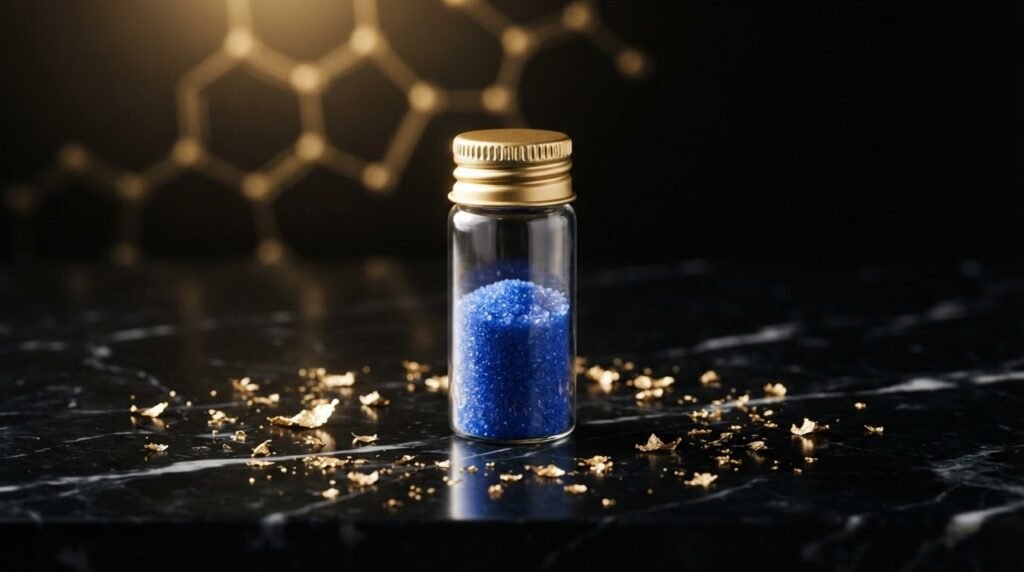
- Appearance: blue to light-blue solid; supplied lyophilized
The difference between the two formulas comes from the copper. When Cu(II) binds, the peptide gives up two protons, which is why the complex lists 22 hydrogens rather than 24. A careful supplier states which form is in the vial: the free peptide, the 1:1 copper complex or a salt such as the acetate. Each has its own CAS number and molecular weight, and mixing them up leads to calculation errors downstream.
Structure and Copper Coordination
GHK belongs to a class that chemists write as H2N-Xxx-His: peptides with a free N-terminal amine followed by histidine in the second position. This arrangement is known in coordination chemistry as a particularly efficient binding site for Cu(II).
How the copper is held
Spectroscopic, potentiometric, calorimetric and crystallographic studies agree on the main binding pattern. The copper ion is held by three nitrogen atoms from the peptide:
- the amino nitrogen of glycine
- the deprotonated amide nitrogen of the Gly-His peptide bond
- a nitrogen of the histidine imidazole ring
That leaves a fourth position in the copper’s equatorial plane open. In solution it can be taken by water or by a second ligand, which forms what is called a ternary complex. Published work has examined ternary complexes of Cu(II)-GHK with small molecules such as urocanic acid.
Charged groups that matter in the lab
GHK has four exchangeable protons: on the lysine side-chain amine, the N-terminal amine, the histidine imidazole and the C-terminal carboxylate. Their protonation states change with pH. That affects how the peptide binds copper, how it behaves on a chromatography column and how it appears in a mass spectrum.
A tool for structural biology
GHK’s copper affinity has found a practical use outside peptide chemistry. In a 2020 study, researchers fused the GHK sequence to the N-terminus of test proteins as a “tag.” The bound copper helped the proteins crystallize. It also provided a strong anomalous signal for copper-based phasing, a technique used to solve X-ray crystal structures.
Discovery History
GHK was first described in 1973 by the biochemist Loren Pickart. He was studying an activity in a human plasma albumin fraction that changed the pattern of protein synthesis in cultured liver tissue. Follow-up work identified that activity as the tripeptide glycyl-L-histidyl-L-lysine and showed its strong affinity for copper.
In 1980, Pickart and colleagues reported in Nature that the tripeptide readily forms complexes with copper(II). They noted a structural similarity between GHK and the copper transport site on serum albumin, where copper is bound to a histidine next to a basic residue. On that basis they proposed that GHK might take part in copper transport into cells. Separate equilibrium-dialysis studies found that the tripeptide could compete with albumin for Cu(II) at pH 7.5.
Researchers later noted that the Gly-His-Lys sequence also appears within the α2(I) chain of type I collagen. That observation led to the hypothesis that the tripeptide can be released when collagen is broken down by proteases. Since then, the copper complex has been studied in a wide range of cell-culture and preclinical models, and it remains a common subject of in-vitro work.
How Identity and Purity Are Verified
For a compound this small, two analytical methods do most of the work.
HPLC-UV for purity
High-performance liquid chromatography separates the sample into its components. A UV detector then measures how much of the signal belongs to the main peak. Purity is reported as that main peak’s share of the total peak area. Related impurities, such as truncated sequences or by-products of synthesis, show up as smaller separate peaks.
LC-MS for identity
Liquid chromatography coupled with mass spectrometry confirms that the main peak has the expected mass. For GHK-Cu, the analyst checks the observed mass against the calculated values for the peptide and its copper complex.
What our current lot shows
Our GHK-Cu 50 mg (lot GBBM-GHK-022) was tested by an independent US laboratory, Freedom Diagnostics Testing, and reported on May 3, 2026:
- Identity (LC-MS): confirmed as GHK-Cu
- Purity (HPLC-UV): >99%
- Net content: 54.50 mg
- Appearance: blue lyophilized powder
When you read any certificate of analysis, check three things. The lot number should match your vial. The method should be named, not just the result. The test date should be recent enough to cover the material you received.
Storage and Handling Notes
Chemical suppliers generally list GHK-Cu for storage sealed, dry and protected from light, with 2–8 °C commonly cited and an inert atmosphere recommended for long-term storage. As with most lyophilized peptides, moisture and repeated temperature swings are the main risks to stability. Let a cold vial reach room temperature before opening so condensation does not form on the powder.